
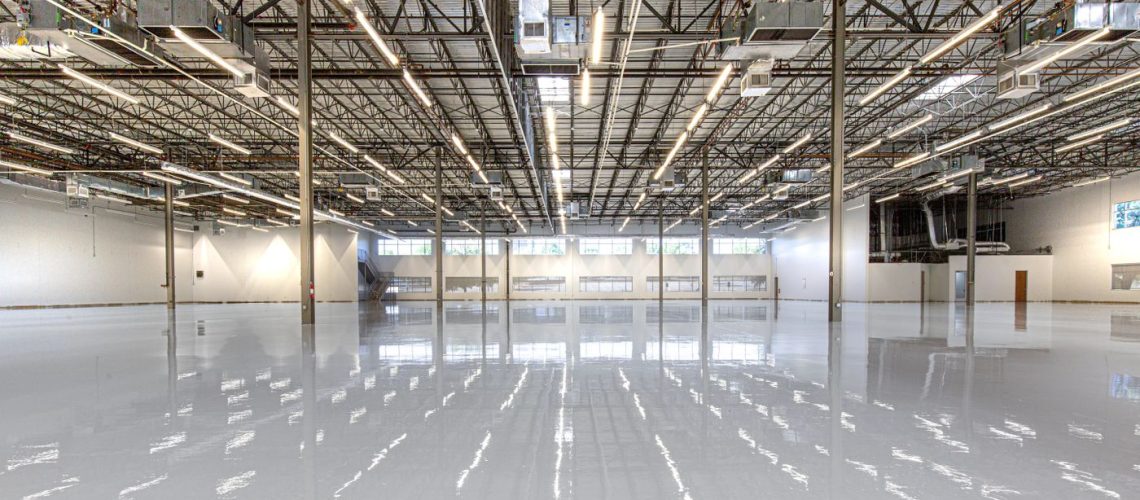
The best floor coating for a warehouse in most Memphis facilities is a high build epoxy system, because it carries forklift traffic, resists abrasion, and costs less to install across large square footage than the alternatives. That answer changes fast once conditions change. Facilities with thermal shock, wash down, or food processing need urethane cement, which handles hot water and steam that would delaminate epoxy. Operations that cannot shut down for several days need polyaspartic, which returns to service in about a day. And warehouses with heavy chemical exposure need a chemical resistant system selected against the specific substances on site. The coating itself is only half the decision. Slab condition, moisture in the concrete, and how much downtime you can afford decide more warehouse floor projects than the resin does. This guide covers each system, when it fits, and what to test before anyone quotes the job.
Table of Contents
- Start With How the Floor Is Used
- Epoxy Systems
- Urethane Cement
- Polyaspartic and Polyurea
- The Moisture Test That Decides Everything
- Surface Prep and Joints
- Safety Markings and Traction
- Frequently Asked Questions
Start With How the Floor Is Used
Five questions narrow the field before any product is named.
- What runs on it? Pallet jacks and foot traffic are one load case. Loaded forklifts with hard wheels turning in the same aisles are another entirely, and point loading from steel wheels is what breaks down a thin coating.
- What gets spilled? Hydraulic fluid and battery acid from a charging area are different problems from food grade oils or cleaning chemicals. Chemical resistance is selected against actual substances, not in general.
- Does it get wet or hot? Wash down, steam cleaning, or hot liquid on the slab is the single biggest factor in ruling epoxy out.
- How long can you be down? This constraint decides more projects than performance does.
- What is the slab like now? Age, cracks, previous coatings, and moisture all affect what can go on top.
Answer those honestly and the choice usually becomes obvious. Answer them optimistically and you get a floor that fails in two years.
Epoxy Systems
Epoxy is the default for a reason. It bonds hard to properly prepared concrete, builds thickness, resists abrasion, and covers large areas economically.
For warehouse duty, the important variable is film thickness. A thin roll applied coating is a maintenance product, not a traffic surface. High build and self leveling systems put down real thickness, and that thickness is what survives forklift traffic. Aggregate broadcast into the system adds both wear resistance and traction where it is needed.
The limits are worth knowing. Epoxy is rigid, so it does not bridge a moving crack. It yellows under direct ultraviolet exposure, which matters near large open doors and skylights. And it has a temperature ceiling, which is why hot wash down environments need something else. The American Concrete Institute publishes technical guidance on concrete surfaces that underpins most of these specifications.
Urethane Cement
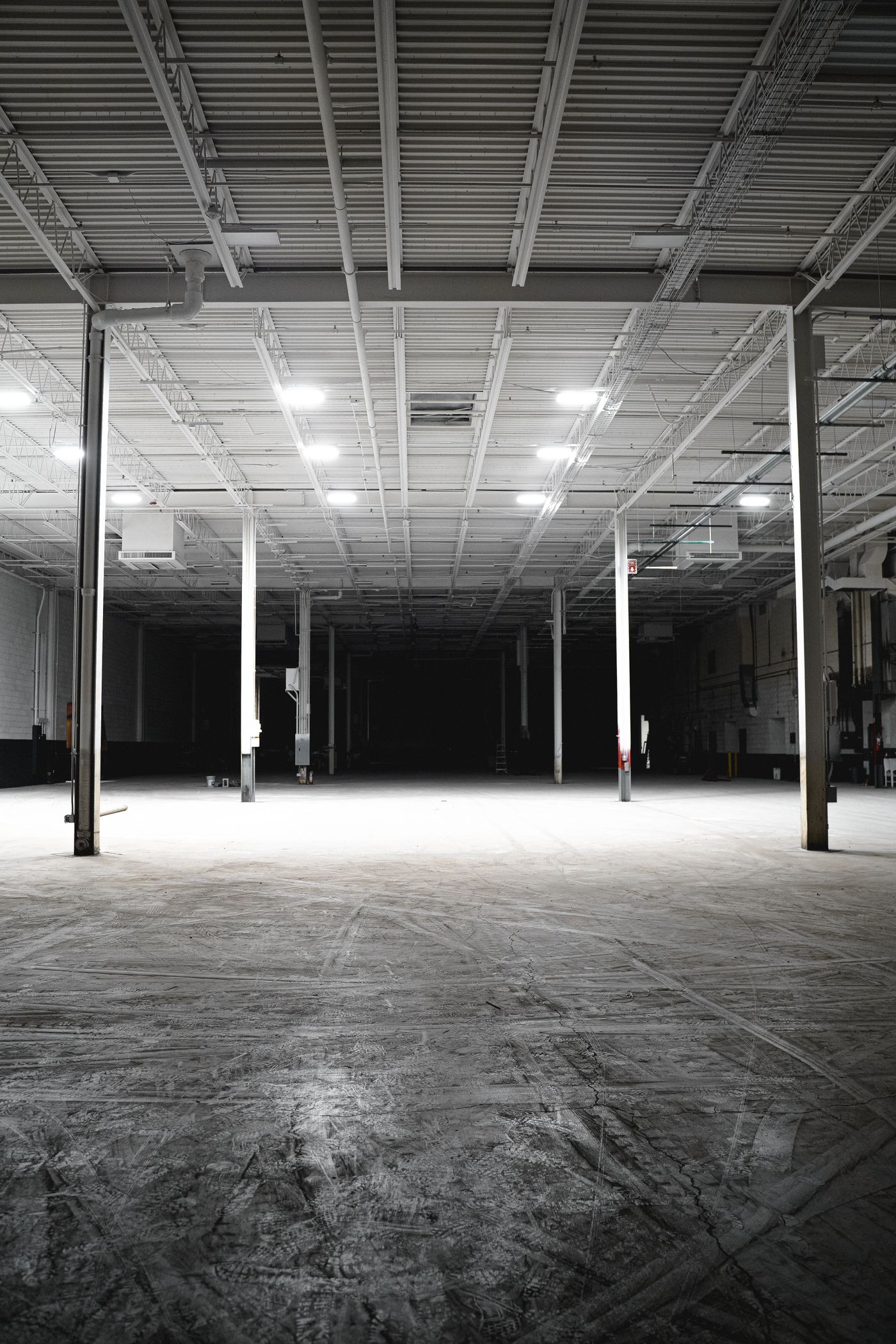
Urethane cement is the answer when heat and water are involved. It is a thick, trowel applied system that tolerates thermal shock, meaning it can take hot water or steam on a cold slab without releasing.
That property makes it the standard in food and beverage processing, cold storage, commercial kitchens, and anywhere the cleaning protocol involves hot water. It also has a useful secondary advantage: it can be installed over slabs with higher moisture content than epoxy tolerates, because the system is more forgiving of vapor transmission.
It costs more and it looks industrial rather than glossy. In the environments that need it, neither of those matters.
Polyaspartic and Polyurea
These cure fast. That is the entire argument, and in an operating warehouse it is often a decisive one.
A polyaspartic system can be installed and returned to service in roughly a day, against several days for a full epoxy build. For a distribution center that cannot stop, the difference in lost operating time dwarfs the difference in material cost. Polyaspartic also holds color under ultraviolet light, so it does not yellow near doors and windows, and it stays flexible enough to handle minor slab movement better than epoxy.
The tradeoffs are a short working time that demands an experienced crew, and a higher material cost per square foot. Many warehouse projects use a hybrid: an epoxy base for build and a polyaspartic topcoat for speed, ultraviolet stability, and wear. Our comparison of polished concrete and epoxy covers a related decision.
The Moisture Test That Decides Everything
More warehouse coatings fail from moisture than from traffic, and it is entirely preventable.
Water vapor moving up through a slab pushes against the underside of a coating. If the rate exceeds what the system tolerates, the coating releases in sheets or blisters, usually within the first year. Slabs poured without a vapor barrier, slabs on grade with a high water table, and older slabs in the Memphis river plain are all candidates.
Testing is straightforward and should be non negotiable before a quote is accepted. Relative humidity probes placed into the slab give the most reliable reading, and calcium chloride testing measures the vapor emission rate at the surface. Where readings come back high, the fix is a moisture mitigation primer designed for the measured level, installed before the coating system. Skipping the test to save a day is how a facility ends up recoating a floor it already paid for. Our post on why epoxy floors peel covers the same failure mode at residential scale.
Surface Prep and Joints
Adhesion comes from mechanical profile, not from the product. The slab has to be mechanically abraded, by diamond grinding or shot blasting, to open the surface and remove laitance, curing compounds, and old coatings. Acid etching does not produce an adequate profile for a warehouse system.
Repairs come next. Spalls, pop outs, and damaged joint edges get filled with a compatible patching material. Cracks are treated according to whether they are moving or static, and a moving crack coated over will reappear through the finish.
Control joints deserve specific attention in a warehouse. Filling them with a semi rigid joint filler supports the joint edges against forklift wheel impact, which is where slab damage usually starts. Coating straight across an unfilled joint transfers that impact directly into the coating and the concrete beneath it.
Safety Markings and Traction
A warehouse floor is a safety system as much as a wear surface, and the coating is the opportunity to build that in.
Integral striping for aisles, pedestrian walkways, staging areas, and equipment zones lasts far longer as part of the coating than as tape or paint applied on top. Color coding areas is a cheap way to make traffic patterns obvious to everyone on the floor.
Traction matters most where floors get wet, near dock doors, and at wash stations. Aggregate broadcast into the coating raises slip resistance, and the correct approach is to target it where it is needed rather than texturing the whole floor, since aggressive texture is harder to clean. OSHA’s walking and working surfaces standard covers employer obligations here. Our post on whether epoxy floors are slippery explains how the texture is built in.
Frequently Asked Questions
How long does a warehouse floor coating last?
A properly specified and installed system in a warehouse typically serves many years before recoating, with wear concentrated in traffic lanes and turning areas. Preparation and moisture testing affect lifespan more than the product choice does.
Can a warehouse floor be coated in sections?
Yes, and phasing by bay or aisle is common in facilities that cannot shut down. It requires planning around cure times, equipment access, and dust control from the grinding.
What is the best floor coating for a warehouse with forklifts?
A high build epoxy or an epoxy system with a polyaspartic topcoat, with filled control joints. Joint edge support matters as much as film thickness, because that is where forklift damage begins.
Does a warehouse floor need to be tested for moisture first?
Yes. Vapor transmission is the leading cause of coating failure on slabs on grade. Test before specifying, and mitigate if the readings exceed what the system tolerates.
Ready to Spec Your Warehouse Floor?
Memphis Coatings Company installs warehouse floor coatings and industrial shop coatings across Greater Memphis. Contact us to have the slab tested before anything is specified.